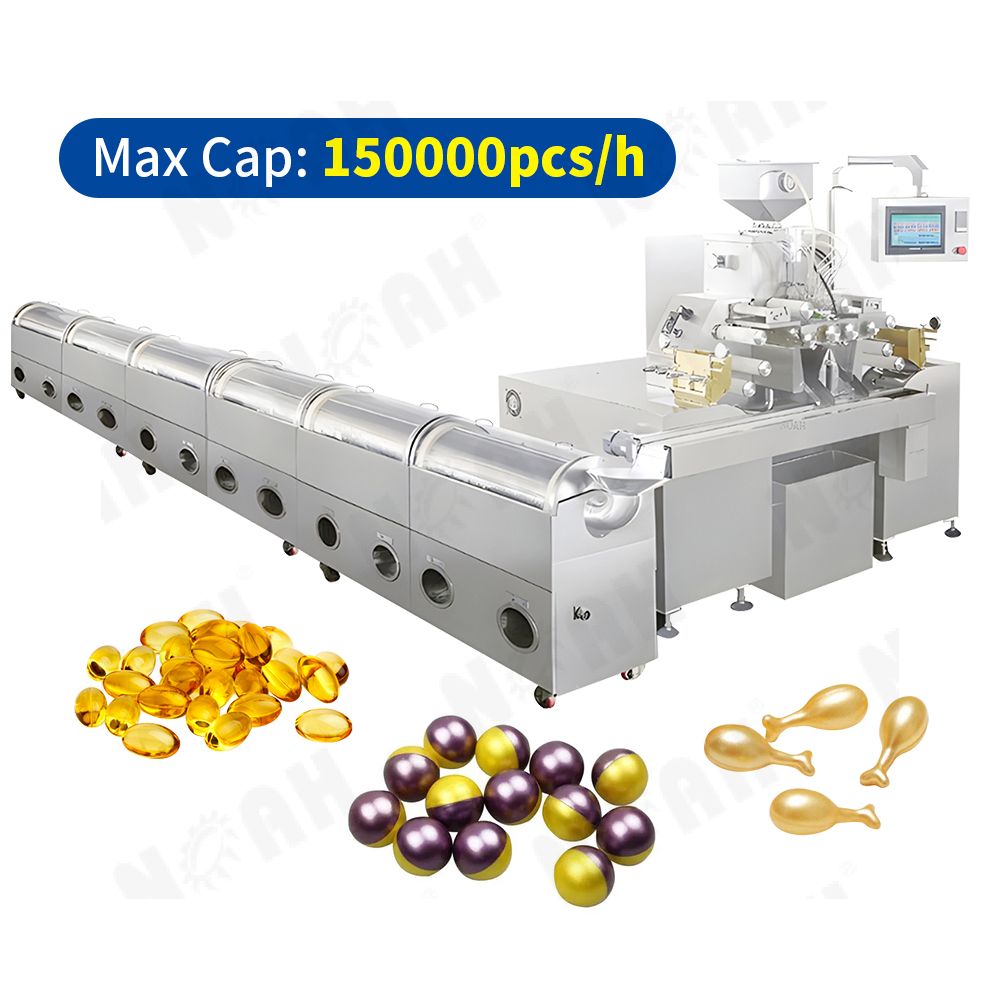
Capsule Machine Size 4


Size 4 capsules are the format where capsule filling stops being a bulk-handling exercise and becomes a microlitre-precision dosing problem. With a body fill volume of approximately 0.21 mL, a size 4 capsule holds less than half the volume of a size 0, and the dosing disc bore that forms the powder plug is small enough that bore tolerance, powder compressibility, and plug-transfer geometry — not machine speed — become the variables that decide whether the batch passes content uniformity. I have spent years resolving size 4 filling problems that were misdiagnosed as formulation issues, and in the majority of cases the root cause was the machine's dosing disc precision, the powder bed management, or a mismatch between the plug-forming geometry and the powder's flow properties. This guide is about the physics of filling a small capsule well — not the generalities of capsule filling, but the specific engineering that size 4 demands.
Capsule sizes are not interchangeable formats that differ only in dimensions; each size creates a distinct dosing problem because the ratio of plug volume to surface area, the plug's aspect ratio, and the dosing bore diameter all change. Size 4 has a body internal diameter of approximately 4.7 mm and a fill depth of roughly 12 mm — a slim, deep cavity. The dosing disc bore for a size 4 filler is typically 4.0–4.5 mm, and the tamping pins that compress the powder in that bore are correspondingly slender. At these dimensions, a bore-diameter variation of 0.02 mm — which is negligible in a size 0 bore of 8 mm — changes the plug volume by roughly 2%, which at a 100 mg target fill is 2 mg. For a low-dose potent API at 0.5 mg in that 100 mg fill, a 2 mg fill-weight variation can move the API content by the full acceptance band.
The fundamental issue is that dosing precision scales with volume, but variance does not scale down proportionally. The absolute tolerance on a dosing disc bore — whether machined to ±0.01 mm or ±0.005 mm — is a manufacturing constant, but its impact on fill weight is volume-dependent. In a size 0 bore, a 0.01 mm tolerance is a 0.4% volume change; in a size 4 bore, the same tolerance is a 0.9% volume change. This is why a filler that fills size 0 capsules at 1.2% RSD may fill size 4 at 2.5% RSD with the same dosing disc quality. Size 4 demands a higher grade of dosing disc precision — and not every capsule filler manufacturer delivers it.
After the powder plug is formed in the dosing disc, it must be transferred into the capsule body. For a size 4 plug — a slim column of compressed powder 4 mm in diameter and 10–12 mm long — the transfer is mechanically delicate. The plug must retain its integrity during transfer; if it crumbles, the fill weight is inconsistent, and if it bridges in the transfer tube, the capsule is underfilled or empty. The transfer tube bore, the ejection pin timing, and the capsule body alignment must all be tighter for size 4 than for larger sizes, because there is less margin for geometric mismatch.
The table below presents fill-weight and content-uniformity data from size 4 production runs on precision-bored tamping pin fillers. The formulations span free-flowing granulated, direct-compression blend, and low-dose potent API, illustrating how powder type interacts with the size 4 dosing geometry.
| Formulation | Target Fill (mg) | API Dose (mg) | Dosing Disc Bore (mm) | Tamping Stations | Fill-Weight RSD | Content Uniformity (AV) |
|---|---|---|---|---|---|---|
| Granulated, free-flowing | 180 | 50 | 4.5 (±0.01) | 5 | 1.4% | 3.2 (pass) |
| Direct-compression blend | 130 | 10 | 4.2 (±0.01) | 5 | 2.1% | 6.8 (pass) |
| Low-dose potent, diluted | 100 | 0.5 | 4.0 (±0.005) | 5 + pre-tamp | 2.8% | 11.4 (pass, tight) |
| Low-dose potent, standard disc | 100 | 0.5 | 4.0 (±0.01) | 5 | 4.2% | 16.1 (fail) |
Compare the last two rows. Same formulation, same target fill, same machine type — the only difference is the dosing disc bore tolerance (±0.005 mm vs ±0.01 mm) and the addition of a pre-tamping step. The precision-bored disc with pre-tamp passes content uniformity at AV 11.4; the standard disc fails at AV 16.1 (the USP <905> limit is 15). This is the case for specifying precision-bored dosing discs and pre-tamping for low-dose size 4 filling: it is the difference between a batch that releases and a batch that fails. The cost of a precision disc is a fraction of the cost of a failed batch, yet it is routinely omitted from the specification because the buyer did not know it mattered.
For a size 4 capsule containing a low-dose API, content uniformity is the critical quality attribute that defines the process. USP <905> and Ph. Eur. 2.9.40 set acceptance value (AV) limits, and for low-dose products the acceptance band is tight because the therapeutic window is narrow. The capsule machine's contribution to content uniformity is governed by the dosing disc precision, the powder bed management, and the consistency of tamping — all of which must be specified, controlled, and documented in the equipment qualification. A machine that cannot demonstrate consistent dosing at the size 4 bore geometry cannot be qualified for a low-dose size 4 product, regardless of its performance on larger sizes.
CE marking under the Machinery Directive applies to the machine's safety architecture, and for a size 4 filler the small tooling — slender tamping pins, thin dosing discs, and delicate transfer tubes — presents a specific hazard: the pins and tubes can bend or break if the machine is misaligned or if a foreign object enters the dosing zone. The interlocked guarding must prevent access during the dosing cycle, and the machine's control system should detect a bent or broken pin (through force or position monitoring) and stop before the damaged tooling produces a run of defective capsules or damages the die. This is a feature that distinguishes a filler designed for small-format precision from one adapted to it.
For size 4 filling, the dosing disc is the single most important component, and its manufacturing precision is the single most important quality attribute. ISO 9001 certification of the machine manufacturer underpins the dimensional control of the dosing disc bores, the traceability of the boring process, and the consistency of replacement discs. A manufacturer that cannot provide dimensional inspection certificates for each dosing disc — showing bore diameter, roundness, and surface finish — cannot guarantee that a replacement disc will match the original's performance. For a low-dose size 4 product, a replacement disc that is 0.01 mm out of tolerance can shift the process from passing to failing content uniformity.
Powder bridging in the dosing bore. The 4.0–4.5 mm bore of a size 4 dosing disc is narrow enough that cohesive powders can bridge — forming an arch across the bore that prevents consistent filling. The result is intermittent underfilling that produces weight variation spikes. The remedy is a filler with an agitated powder feed mechanism (a rotating or oscillating feed frame that keeps powder moving into the bores) and, for highly cohesive powders, a pre-tamping step that lightly compacts powder into the bore before the main tamping stations. A filler with gravity feed alone cannot reliably fill cohesive powders into a size 4 bore.
Dosing disc wear and precision drift. The small bore of a size 4 dosing disc wears faster than a larger bore, because the same tamping-pin cycles remove material from a smaller circumference. A disc that starts at 4.00 mm may drift to 4.03 mm after 6 months of production, which is a 1.5% volume change — enough to shift content uniformity on a low-dose product. The remedy is a documented disc-replacement interval based on dimensional inspection, not on visual assessment. A disc that "looks fine" may already be out of tolerance.
Transfer-tube misalignment and plug loss. The size 4 plug is slender and fragile; if the transfer tube is not precisely aligned with the capsule body, the plug crumbles on entry and the fill weight drops. The alignment must be verified at every format change and after any maintenance that disturbs the dosing station. A filler with quick-release, self-aligning transfer tubes reduces the alignment risk; one with manually adjusted tubes depends on the technician's skill and consistency.
"A filler that runs size 0 can run size 4." Mechanically, yes — with the correct change parts. But the dosing precision required for size 4 is higher, and not every filler manufacturer's dosing discs deliver it. A filler whose size 0 performance is excellent may produce unacceptable weight variation on size 4 because its standard dosing disc tolerance is adequate for 8 mm bores but not for 4 mm bores. Request size 4-specific performance data — fill-weight RSD on a size 4 disc — before assuming the machine is suitable.
"Standard dosing disc tolerance is adequate for low-dose size 4." It is not. For a low-dose potent API in size 4, the dosing disc bore tolerance must be ±0.005 mm or better, and the disc should be precision-bored and individually inspected. Standard tolerance (typically ±0.01 mm) is adequate for high-dose or mid-dose products but will fail content uniformity on a sub-milligram API. The precision disc is a low-cost, high-impact specification that should be mandatory for low-dose size 4 filling.
"Pre-tamping is unnecessary if the powder flows well." Pre-tamping serves two purposes: it de-aerates the powder in the bore (which improves plug consistency) and it increases the effective tamping depth (which improves density uniformity). Even for free-flowing powders, pre-tamping reduces fill-weight RSD by 0.3–0.8 percentage points on size 4, which is significant when the acceptance band is tight. It is a low-complexity, high-value feature for size 4 filling.
| Criterion | Standard Tamping Pin | Precision-Bored + Pre-Tamp | Dosator (Size 4 Capable) |
|---|---|---|---|
| Dosing disc bore tolerance | ±0.01 mm | ±0.005 mm | N/A (dosator tube) |
| Pre-tamping station | No | Yes | Single-stage (dosator plunger) |
| Powder feed | Gravity or agitated | Agitated, level-controlled | Agitated, level-controlled |
| Size 4 fill-weight RSD (low-dose) | 3.5–4.5% | 2.5–3.0% | 2.8–3.5% |
| Plug transfer robustness | Moderate | Good (pre-tamped plug is denser) | Good (plug formed in dosator, less handling) |
| Best fit for size 4 | High-dose, free-flowing only | Low-dose, potent API | Free-flowing to moderate powders |
Request size 4-specific fill-weight RSD data. Do not accept performance data from size 0 or size 1 runs as evidence of size 4 capability. Ask the supplier to provide fill-weight RSD and content uniformity data from a size 4 run on a representative powder. If the supplier cannot provide this, request a trial run on a size 4 disc at FAT with your powder. The cost of a trial is trivial compared to the cost of discovering at PQ that the machine cannot hold content uniformity on size 4.
Specify precision-bored dosing discs as standard. State in the URS that dosing discs for size 4 must be bored to ±0.005 mm with individual dimensional inspection certificates. Require a spare disc with each machine and a documented disc-replacement interval based on dimensional inspection. This specification adds minimal cost and prevents the most common cause of size 4 content uniformity failure.
Verify the powder feed mechanism for cohesive powders. If your size 4 formulation is cohesive (common for low-dose blends diluted in microcrystalline cellulose), confirm the filler has an agitated, level-controlled powder feed. A gravity-fed filler will bridge in the size 4 bore and produce intermittent underfilling. Ask for a demonstrated run with a cohesive surrogate powder at FAT.
Require plug-transfer verification at format change. The transfer tube alignment for size 4 must be verified at every format change. Ask the supplier how alignment is verified (mechanical gauge, optical, or by first-capsule inspection) and whether the transfer tubes are self-aligning or manually adjusted. Self-aligning transfer tubes reduce the changeover risk and the dependence on operator skill, which is critical for a small-format plug that is sensitive to misalignment.
A European pharmaceutical company filling a 0.5 mg potent API in a size 4 capsule (100 mg total fill, diluted 200:1 in microcrystalline cellulose and lactose) was failing content uniformity on a standard tamping pin filler with dosing discs bored to ±0.01 mm. Fill-weight RSD was 4.2%, and the acceptance value across three PQ batches was 15.3, 16.1, and 14.8 — straddling the USP <905> limit of 15. The team's initial response was to rework the blend (additional screening, longer mixing time), which reduced RSD marginally to 3.8% but did not reliably pass CU.
The investigation focused on the dosing disc. A precision-bored disc (±0.005 mm tolerance, individually inspected) was manufactured, and a pre-tamping station was retrofitted to the first tamping position. Fill-weight RSD dropped to 2.6%, and the acceptance value across the next three PQ batches was 10.8, 11.2, and 10.4 — comfortably within the USP limit. The formulation had not changed; the blend was the same. The root cause was the dosing disc's bore tolerance, which at ±0.01 mm was adequate for size 0 but not for a 4 mm size 4 bore carrying a sub-milligram API.
The precision disc and pre-tamp retrofit cost approximately 4% of the filler's capital cost. The failed PQ batches, the formulation rework effort, and the three-month delay to market launch cost substantially more. The lesson: for low-dose size 4 filling, the dosing disc tolerance is not a component specification — it is the process specification, and it should be the first parameter defined in the URS.
Because the dosing bore is smaller, the same absolute tolerance has a larger relative impact on fill volume. A 0.01 mm bore tolerance on a 4 mm size 4 bore is a 0.9% volume change; the same tolerance on an 8 mm size 0 bore is a 0.4% change. For a low-dose API where the content uniformity band is tight, this difference is enough to move the process from passing to failing. Size 4 demands precision-bored discs (±0.005 mm) that are not always necessary for larger sizes.
A size 4 capsule has a body volume of approximately 0.21 mL (approximately 0.14 g for a powder with a tapped bulk density of 0.65 g/mL). The practical fill-weight range is roughly 80–180 mg, depending on the powder's bulk density and the tamping depth. Below 80 mg, the fill depth is too shallow for reliable plug formation; above 180 mg, the powder may need to be densified by granulation or by increasing tamping force. If your target fill weight falls outside this range, a different capsule size may be more appropriate.
For free-flowing to moderately cohesive powders, a dosator filler can match a tamping pin filler on size 4, with the advantage of simpler changeover. For highly cohesive or low-dose potent powders, the tamping pin's multi-stage compaction and the precision-bored disc offer better content uniformity, because the incremental densification produces a more consistent plug. The choice depends on the powder's flow properties and the dose's uniformity requirement, not on a universal ranking of mechanisms.
The replacement interval depends on production volume, powder abrasiveness, and tamping force. Rather than a fixed interval, establish a dimensional inspection program: measure the bore diameter at defined production milestones (e.g., every 500,000 capsules) and replace the disc when the bore exceeds the tolerance limit (typically +0.02 mm from nominal). A disc that is within tolerance "looks fine" but may be out of specification; dimensional inspection is the only reliable method.
Prioritise precision change parts (±0.005 mm dosing discs for every size), self-aligning transfer tubes, an agitated powder feed, and pre-tamping capability. In a multi-product facility, the filler will run several formulations of varying flow properties and dose strengths, and the tooling and feed system must handle the most demanding product — typically the lowest-dose, most cohesive formulation. Specifying the filler against the worst-case product, not the average product, ensures that every product in the portfolio can be filled to specification.
Written by David Shi | Chief Industrial Application Engineer
David Shi is a Chief Industrial Application Engineer with 9 years of specialized experience in industrial drying system design, equipment selection, and production process optimization. He focuses on delivering tailored solutions for pharmaceutical, food, and chemical manufacturing, with proven expertise in GMP compliance, ISO 9001 standards, and large-scale production line integration.
Contact Us
Related Information!
Tablet Compression MachineBuy Capsule Filling MachineFluidized Bed DryerMilk Tablet PressRotary Tablet MachineMedicine Capsule Filling MachinePharmaceutical Equipment ManufacturersCapsule Machine AustraliaBlister Pack for TabletsTablet Compression Machine PricePill Capsule MachineAutomatic Capsule Filling MachineMachine A BlisterCapsule Filling Machine Size 0Blister Packing Machine PriceTablet Press Machine PriceCandy Press MachineAutomatic Blister Packing MachinePowder to Tablet Making MachineAutomatic Capsule MachinePill Filler MachineTablet Counting MachineAuto Capsule Filling MachineTablet CompressionSnap Packing MachineCapsule FillerFluid Bed DryerCapsule Filling Machine UKTablet Press MachinePill capsule fillerTablet Machine PriceFilling Capsule MachinePharma Equipment ManufacturersCapsule Machine for SaleTablet Making Machine PriceBlister Packing MachineMachine to Fill CapsulesTablet CompressorSoftgel MachineGel Capsule MachineTablet Blister Packing MachineFluidized Bed DryingBlister Packaging MachineAutomatic Capsule Filling Machine UKLiquid Capsule Filler