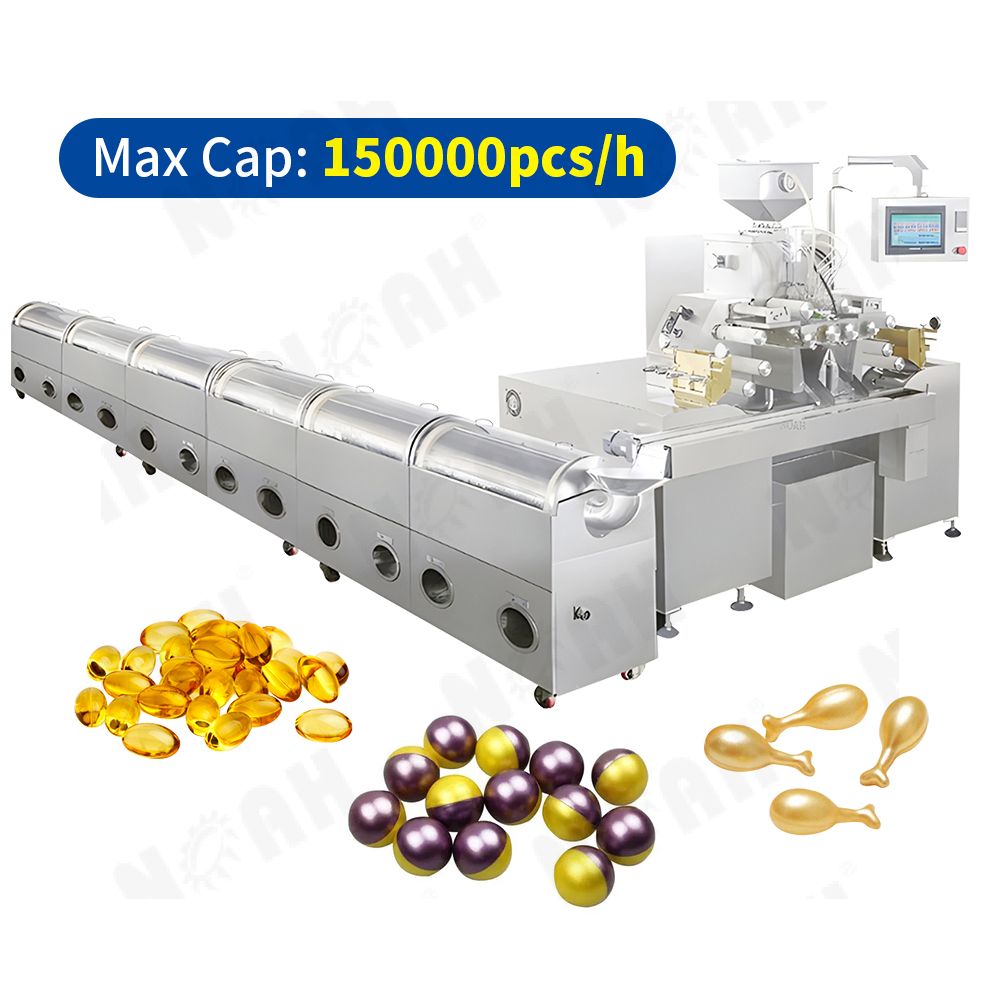
Auto Capsule Filling Machine


The rated speed printed on an auto capsule filling machine's nameplate is the number you will almost never see in production. Real output is governed by OEE — overall equipment effectiveness — and the factor that crushes OEE faster than any other in multi-SKU capsule plants is changeover time, not fill speed. I have audited capsule lines in the Middle East and Southeast Asia where a machine rated at 150,000 capsules per hour was delivering 70,000 effective capsules per hour across a day, because three product changes consumed six hours of the shift. The engineering decision that matters is not "how fast does it fill" but "how fast does it switch formats, revalidate weight, and return to steady state." This guide approaches automatic capsule filling from the OEE angle — dosing mechanism, in-line weight feedback, changeover architecture — because that is where the money is actually won or lost.
An automatic capsule filling machine forms the powder plug inside the capsule body using one of two mechanisms, and the choice propagates into weight control, changeover, and the type of powders you can run.
A dosator is a tube with a plunger that descends into the powder bed, compacts a plug inside the tube, transfers it to the capsule body, and ejects it. The dosator does filling and transfer in one station, which makes the architecture compact and the changeover relatively simple — swap the dosator tubes and the dosing bushings, adjust the plunger stroke, and the format change is largely mechanical. The dosator handles free-flowing to moderately cohesive powders well, and because the plug is formed in a single cavity, weight variation is governed by powder-bed uniformity and plunger-stroke precision.
A tamping pin system forms the plug in a dosing disc — a flat plate with bores — through five (typically) tamping stations that progressively compact the powder into a coherent plug before a transfer tube drops it into the capsule body. The tamping pin mechanism handles cohesive and poorly flowing powders better than a dosator because the multi-stage tamping builds density incrementally, and the powder bed is maintained at a controlled height by a feed mechanism. The trade-off is changeover: the dosing disc, tamping pins, transfer tubes, and capsule-handling bushings all change with capsule size, and the setup requires more precision and time.
The data below comes from OEE studies on automatic capsule fillers in commercial production. The "effective output" column is the number that determines whether the machine pays for itself — it is rated output multiplied by availability, performance, and quality rates across a representative shift with two changeovers.
| Machine Type | Rated Speed | Steady-State Fill Weight RSD | Format Changeover Time | Weight Re-qualification | Shift OEE | Effective Output |
| Intermittent dosator, 3-segment | 45,000 cph | 1.8–2.5% | 35–50 min | 15 min | 72% | ~32,400 cph |
| Continuous tamping pin, 5-station | 100,000 cph | 1.2–1.8% | 75–110 min | 25 min | 64% | ~64,000 cph |
| High-speed dosator, automatic format | 150,000 cph | 1.5–2.2% | 20–30 min (auto) | 10 min (auto feedback) | 78% | ~117,000 cph |
| Mid-speed tamping pin, manual format | 60,000 cph | 1.0–1.5% | 90–120 min | 30 min | 58% | ~34,800 cph |
The high-speed dosator with automatic format changeover and closed-loop weight feedback achieves 78% OEE not because it fills faster in steady state — the tamping pin is marginally more precise — but because it loses 60% less time to changeover and weight re-qualification. In a plant running three to five SKUs per day, that is the difference between a machine that produces 900,000 capsules per shift and one that produces 500,000. The rated speed column is marketing; the OEE column is engineering.
In a GMP environment, capsule fill weight is a critical quality attribute. An automatic capsule filling machine must do more than fill — it must verify, trend, and correct. Modern automatic fillers integrate in-line check-weighers (typically load-cell or balance-based) that weigh 100% of capsules or a statistical sample and feed the data back to the dosing mechanism, adjusting plunger stroke or tamping depth in real time. This closed loop is what makes the machine "automatic" in the GMP sense, not just in the mechanical sense. The audit trail must record every weight measurement, every correction, and every rejection — and the rejection gate must be physically verified during PQ.
CE marking under the Machinery Directive governs the safety of the automatic filler's moving parts — the dosing turret, the capsule-separation mechanism, and the closing station all present pinch and crush hazards. The interlocked guarding must prevent access during motion, and the door interlocks must be fail-safe (dual-channel, monitored). For high-speed continuous-motion fillers, the stopping time of the turret is a safety-critical parameter: the guard door must not be openable before the turret has stopped, and this must be validated at FAT.
ISO 9001 matters for an automatic capsule filler in a specific way: change parts. Every capsule size requires a set of dosing bushings, dosing discs, transfer tubes, and capsule-handling segments. If the manufacturer's ISO 9001 system does not control the dimensional tolerance of these parts tightly, each new set of change parts behaves slightly differently, and changeover re-qualification becomes unpredictable. I require suppliers to provide dimensional inspection certificates for every change-part set, not just the first.
Changeover time eating availability. The single largest OEE drain in multi-SKU capsule plants. A manual format change on a tamping pin filler — disassemble the dosing disc, swap tamping pins, reassemble, re-time the transfer station, run weight checks — routinely consumes 90 to 120 minutes. Automatic format changeover, where servo-driven mechanisms adjust to recipe-selected positions without manual disassembly, cuts this to 20–30 minutes. The capital premium for automatic format is recovered within the first year for any plant running more than two SKUs per day.
Weight drift after changeover. After a format change, the dosing mechanism must be re-qualified to the target fill weight. A machine with closed-loop weight feedback and auto-correction returns to steady-state fill weight in 10–15 minutes; a machine without it relies on operator sampling and manual stroke adjustment, which can take 30–45 minutes and produce a longer tail of out-of-spec capsules. The closed-loop system is not a convenience — it is a yield protection feature.
Capsule separation and split-cap failures. Before filling, the automatic filler must separate the capsule body from the cap. If the vacuum or mechanical separation is inconsistent, the dosing station fills a partially closed body, and the closing station crushes it. High split-cap reject rates on start-up and after changeover indicate a separation station that is not tuned to the capsule lot's dimensional variation. A machine with adaptive separation force control handles lot-to-lot variation; one with fixed force does not.
"Rated speed equals real output." This is the misconception I encounter most. A 150,000 cph rating means 150,000 in steady state with a single product and no stops. In a multi-SKU plant, effective output is 55–80% of rated, depending on changeover architecture. Comparing machines on rated speed without modelling OEE is the most common reason a plant buys more capacity than it can use — or less than it needs.
"Tamping pin is always more accurate than dosator." Tamping pin achieves lower RSD on cohesive, poorly flowing powders because of multi-stage compaction. On free-flowing granulated powders, the dosator matches or exceeds tamping-pin precision with faster changeover. The mechanism should be selected against the powder's flow properties, not against a generalised accuracy ranking.
"Automatic weight correction is optional." In a GMP-regulated plant, it is not optional — it is the control strategy. Without closed-loop weight feedback, fill weight is controlled by operator sampling, which is not a validated control strategy for a critical quality attribute. The cost of retrofitting in-line weighing and feedback onto a machine that lacks it is substantial and often not feasible.
| Criterion | Intermittent Dosator | Continuous Tamping Pin | High-Speed Dosator (Auto) |
| Motion type | Indexing (stop-fill-move) | Continuous rotary | Continuous rotary |
| Best powder match | Free-flowing to moderate | Cohesive, poorly flowing | Free-flowing, granulated |
| Changeover architecture | Manual, moderate | Manual, complex | Servo-driven, recipe-based |
| In-line weight feedback | Optional | Optional to standard | Standard (closed loop) |
| Typical speed range | 20,000–60,000 cph | 60,000–120,000 cph | 100,000–200,000 cph |
| Capital investment | Low–medium | Medium–high | High |
| Best operational fit | Low-SKU, small-medium batch | High-volume, cohesive powders | Multi-SKU, high-OEE demand |
Model OEE, not rated speed. Before purchase, build a shift model: number of SKUs, changeovers per shift, target batch size, and powder flow characteristics. Apply realistic availability (changeover + maintenance + cleaning), performance (speed derating for your powder), and quality (reject rate) factors. The machine with the lower rated speed but faster changeover will frequently win on effective output. This model takes an hour to build and prevents the most expensive procurement error in the category.
Demand a witnessed changeover at FAT. Ask the supplier to perform a full format change (e.g., size 0 to size 2) in front of you, timed from last good capsule of the old format to first good capsule of the new format. If the supplier cannot demonstrate the changeover time they quoted, the quoted OEE is fiction. This is the single most revealing FAT test for an automatic capsule filler.
Specify the weight-control architecture in the URS. State whether in-line 100% weighing or statistical sampling is required, the target RSD, the correction algorithm (stroke adjustment, tamping depth, dosator tube height), and the audit-trail requirements for weight data. A URS that says "automatic weight control" without defining the architecture will be met with the cheapest interpretation.
Verify change-part dimensional certificates. Require 3.1b-equivalent dimensional inspection for every change-part set purchased, now and in the future. Without this, your second set of size-1 change parts may not match your first, and changeover re-qualification becomes unpredictable.
A contract manufacturing organisation in the Middle East was running a mid-speed tamping pin filler rated at 80,000 cph across eight SKUs — three prescription products and five nutraceuticals — with an average of three changeovers per shift. Changeover took 100–115 minutes each, weight re-qualification added 30 minutes, and effective shift OEE was 56%. The plant was considering buying a second filler to meet demand.
Instead, the plant replaced the filler with a high-speed dosator machine equipped with servo-driven automatic format changeover and closed-loop in-line weight feedback. Changeover dropped to 25 minutes, weight re-qualification to 10 minutes (the auto-feedback loop converged in under 5 minutes of production), and shift OEE rose to 76%. The effective output went from 44,800 cph to 114,000 cph — a 2.5× improvement — without adding a second machine or a second shift. The capital cost of the new filler was recovered in 11 months against the avoided cost of a second line, and the plant absorbed two additional SKUs without further investment.
The insight was not that dosator is better than tamping pin. It was that the bottleneck was changeover and weight re-qualification, not fill speed. Selecting the machine against the bottleneck — not against the brochure — was what unlocked the capacity.
For a plant running two or fewer changeovers per day, the saving is marginal and manual changeover may be acceptable. For three or more changeovers per day, automatic format changeover typically saves 45–70 minutes per changeover, which compounds to 2–3.5 hours per shift. At 100,000 cph effective output, that is 200,000–350,000 additional capsules per day from the same machine — the feature pays for itself in months, not years.
Characterise your powder's flow properties (flow function, compressibility, cohesion) before selecting. Free-flowing to moderately cohesive powders are well served by dosator, which offers simpler changeover. Highly cohesive or poorly flowing powders — typical of low-dose potent APIs diluted in microcrystalline cellulose — are better served by tamping pin, which builds plug density incrementally. If you run both types of powder across different SKUs, the tamping pin's versatility may justify its longer changeover.
It means the filler measures fill weight (100% in-line or by statistical sampling), compares it to the target, and adjusts the dosing mechanism automatically to bring the process back to target — with every measurement, correction, and rejection recorded in the audit trail. This closed loop is the validated control strategy for fill weight. Without it, weight is controlled by manual operator sampling and stroke adjustment, which does not meet GMP expectations for a critical quality attribute.
Verify the machine's operating envelope for temperature and humidity. Capsule filling is sensitive to static and powder flow, both of which worsen at high humidity. If your facility cannot maintain ≤ 25 °C and ≤ 45% RH in the filling room, specify a filler whose powder hopper and dosing station are enclosed and, if necessary, humidity-controlled. Also confirm the electrical panel is rated for the ambient temperature — electronics in panels running above 40 °C ambient fail prematurely, and service support for imported electronics can be slow.
A well-specified machine in a single-SKU dedicated line should achieve 80–85% OEE. In a multi-SKU plant with three or more daily changeovers, 70–78% is realistic with automatic format changeover, and 55–65% is typical with manual changeover. If a supplier quotes OEE above 85% for a multi-SKU operation, ask for the OEE model that produces that number — it usually assumes zero changeover time, which is not your reality.
Written by David Shi | Chief Industrial Application Engineer
David Shi is a Chief Industrial Application Engineer with 9 years of specialized experience in industrial drying system design, equipment selection, and production process optimization. He focuses on delivering tailored solutions for pharmaceutical, food, and chemical manufacturing, with proven expertise in GMP compliance, ISO 9001 standards, and large-scale production line integration.
Contact Us
Related Information!
Capsule Blister Packing MachineSoftgel Capsule MachineCapsule Packing MmachineMedicine Capsule Filling MachineAutomatic Capsule MachineCapsule Making Machine UKMachine TabletFluid Bed GranulationAutomatic Capsule Filling Machine PriceCapsule Filling Machine AustraliaCapsules Making MachineTablet Compression MachineTablet Press MachineTablet Press for SalePress Machine for DrugsTablet Counting MachineTablet Press Machine for Sale South AfricaPill Filler MachineTablet Making Machine PricePharmaceutical Manufacturing EquipmentMachine A BlisterAutomatic Capsule Filling MachineFluidized Bed DryingTablet Press Machine UKAutomatic Capsule Filling Machine UKFluid-bed GranulatorCapsule Sealing MachineAuto Capsule Filling MachineEffervescent Tablet PressPharmaceutical Manufacturing MachinesTablet making machineCapsule Counter MachineGel Capsule MachinePharmaceutical Machine ManufacturerCapsule Filling Machine UKBlister Packing Machine PriceTablet Pressing MachineSingle Punch Tablet PressBuy Capsule Filling MachineCapsule Machine AustraliaPharmaceutical Machinery ManufacturersCapsules Filling MachineTablet Compression Machine PriceTablet Press Machine PriceCandy Tablet Press