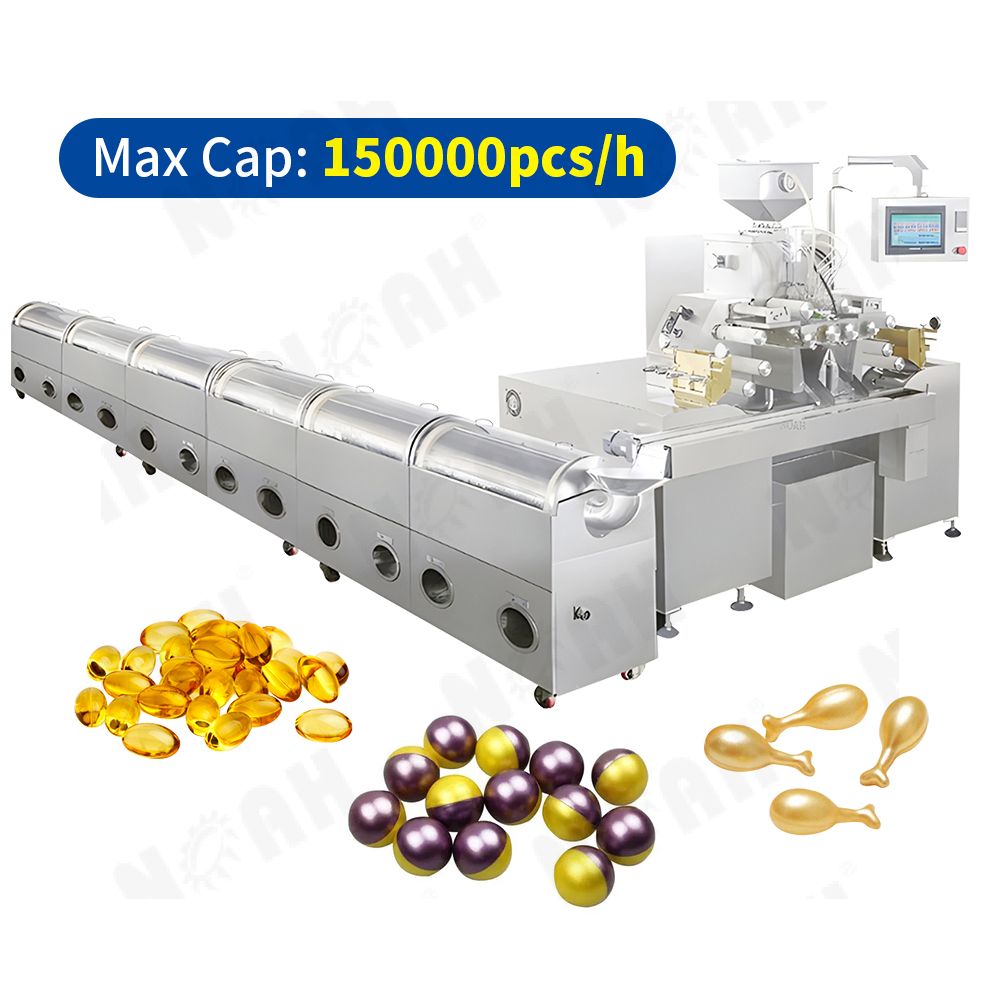
Capsule Machine Price


The price on a capsule filling machine's quotation is roughly 30 to 40 percent of what that machine will cost you over five years. The rest is paid in validation, change parts, service contracts, rejected capsules, unplanned downtime, and — in the worst case — the cost of buying a second machine because the first one could not be qualified. I have built total-cost-of-ownership models for capsule filler purchases across Southeast Asia, the Middle East, and Europe, and the pattern is always the same: the cheapest machine on the purchase order is rarely the cheapest on the balance sheet, and the most expensive machine is sometimes the best value, because its automation, documentation, and service infrastructure reduce the hidden costs that dominate the five-year picture. This guide is about the economics of buying a capsule filler — what drives the price, what the price tiers mean, and how to model the decision so the number on the PO reflects the number on the P&L.
A capsule filler's price is not a single number; it is the sum of several engineering and compliance decisions, each with a cost. Understanding these drivers lets you compare quotations honestly and — more importantly — identify what was omitted from a low quote.
The dosing mechanism (dosator vs tamping pin) and the speed tier (intermittent, continuous, high-speed) set the base price. An intermittent dosator filler at 40,000 cph and a continuous high-speed dosator at 150,000 cph differ in price by a factor of 2.5 to 3.5, because the high-speed machine's frame, turret, servo system, and control architecture are fundamentally more complex. The speed premium is justified only if your batch profile and OEE model support it — a high-speed filler running at 60% OEE because of changeover may cost more per thousand capsules than a mid-speed filler at 78% OEE.
Automatic format changeover (servo-driven, recipe-based) and closed-loop in-line weight feedback are the two features that most dramatically affect both price and OEE. They typically add 20–35% to the base machine price, but they reduce changeover time by 60–75% and weight-re-qualification time by 50–70%. For a multi-SKU plant, the OEE improvement repays the premium in 8–14 months; for a single-SKU dedicated line, the premium may not be justified. The price driver must be evaluated against the operational profile, not as a standalone feature.
Containment grade (open, contained with split-valve, isolator-integrated) and the GMP documentation package (DQ/IQ/OQ/PQ protocols, material certificates, Part 11 compliance, FAT with witnessed tests) are significant price drivers that are frequently omitted from low quotations. A contained filler with a full documentation package costs 30–50% more than the same filler sold as an "industrial" version without GMP documentation. This is not optional for a pharma buyer — the cost of building the documentation retroactively, or of failing a GMP audit, exceeds the price difference many times over.
Change parts (dosing discs, dosator tubes, capsule segments, transfer tubes) for each capsule size are a recurring cost that is often under-quoted. A full set of precision change parts for sizes 0 through 4 can add 8–15% to the machine price, and replacement sets (because parts wear and spare sets are needed for changeover parallelism) add further. Service infrastructure — the local agent's stock, the technician's availability, the remote diagnostics capability — is not a line item on the quotation, but it is a cost that appears as downtime when the machine fails.
The table below presents representative price tiers for automatic capsule fillers in the 40,000–150,000 cph range, sourced from B2B quotations across Asian, European, and Middle Eastern markets in 2024–2025. The five-year TCO column includes validation, change parts, service, consumables, and the cost of downtime based on a multi-SKU operational profile (4 changeovers/day, 250 production days/year).
Price Tier
Purchase Price (USD)
Automation Level
GMP Doc Package
Change Parts (5 sizes, USD)
Annual Service (USD)
5-Year TCO (USD)
Cost per 1M Capsules (5-yr)
Entry (Asian, manual format) | 35,000–55,000 | Manual, no auto weight | Minimal (manual only) | 6,000–9,000 | 3,000–5,000 | 95,000–130,000 | ~$19–26 |
Mid (Asian/EU, semi-auto) | 80,000–130,000 | Semi-auto, statistical weight | Partial (IQ/OQ templates) | 10,000–15,000 | 5,000–8,000 | 170,000–230,000 | ~$13–18 |
Premium (EU, full auto) | 180,000–280,000 | Full auto, closed-loop weight | Full (DQ/IQ/OQ/PQ, Part 11) | 15,000–22,000 | 8,000–12,000 | 290,000–390,000 | ~$10–14 |
Isolator-Integrated (EU) | 350,000–500,000+ | Full auto, isolator co-engineered | Full + isolator qualification | 20,000–30,000 | 15,000–22,000 | 520,000–700,000+ | ~$15–22 (potent API premium) |
The cost-per-million column is the number that matters. The entry-tier filler appears cheapest on purchase price but costs the most per million capsules over five years, because its low OEE (manual changeover, no auto weight, minimal documentation) produces fewer effective capsules and more rejects. The premium tier — three to five times the purchase price of the entry tier — costs roughly half per million capsules, because its automation and documentation drive OEE from ~55% to ~78% and reject rates from 4% to under 1%. This is the core insight of TCO: the purchase price is a down payment, and the operational economics are the mortgage.
A full GMP documentation package (DQ, IQ, OQ, PQ protocols; material certificates; Part 11 compliance statement; FAT with witnessed tests; cleaning validation support) adds 15–25% to the machine price. This cost is non-negotiable for a pharma buyer: without it, the machine cannot be qualified in a GMP environment, and the cost of building the documentation retroactively — if it is possible at all — typically exceeds the original price premium. A machine without GMP documentation is a machine that cannot be used for its intended purpose, and its purchase price is a sunk cost.
CE marking should be included in the price for any machine sold into or through the EU. Some Asian manufacturers offer a "non-CE" version at a lower price for markets that do not require it. For a pharma buyer, the non-CE version is a false economy: the CE technical file contains the safety architecture documentation (interlock logic, stop times, hazard analysis) that supports the equipment's risk assessment, which is part of GMP qualification. Buying non-CE to save 5–8% on the purchase price and then reverse-engineering the safety documentation costs more than the saving and introduces regulatory risk.
ISO 9001 certification of the manufacturer does not add to the machine price, but it is a gating criterion for supplier selection. A manufacturer without ISO 9001 may offer a lower price, but the price reflects the absence of quality-system overhead — and that absence shows up as inconsistent machining, missing material certificates, and change parts that do not match. ISO 9001 is not a price driver; it is a supplier filter.
Hidden validation cost. The validation cost — the labour and time to execute DQ, IQ, OQ, and PQ, including the writing of protocols, the execution of tests, the analysis of data, and the remediation of deviations — is rarely included in the machine quotation. For a mid-tier filler, validation typically costs 15,000–35,000 USD in internal and external labour. For a machine without a documentation package, it can double, because the QA team must reverse-engineer the DQ and IQ from a generic manual. This cost should be modelled in the TCO, not discovered after purchase.
Change-part sticker shock. Buyers frequently discover after purchase that the change parts quoted are for one capsule size only, and that each additional size costs 2,000–5,000 USD per set. For a multi-product facility needing five sizes, the change-part cost can equal 10–15% of the machine price. Always request a quotation that includes all required sizes, and ask for the price of replacement sets (because parts wear and parallel changeover requires duplicate sets).
The service desert. A machine purchased from a supplier with no local service presence, no stocked spares, and no remote diagnostics capability carries a hidden cost: every failure that requires a part or a technician incurs a lead-time penalty of one to four weeks. At a production rate of 100,000 capsules per day and a margin of 5 USD per thousand, a two-week downtime costs 7,000 USD in lost contribution — and that is for a single failure. Over five years, a machine in a service desert will incur multiple such events, and the cumulative downtime cost can exceed the purchase price.
"The cheapest machine that meets the spec is the best value." Only if the spec captures all the cost drivers — which it rarely does. A spec that lists speed, dosing mechanism, and capsule sizes but omits automation level, documentation package, change-part pricing, and service infrastructure will select the cheapest machine on the visible spec and the most expensive on the hidden costs. The spec must include TCO-relevant criteria, or the procurement decision is optimised for the wrong objective.
"I do not need automatic weight control because my operators are skilled." Operator skill does not constitute a validated control strategy for a critical quality attribute. In a GMP environment, fill weight must be controlled by a documented, validated method — and closed-loop automatic weight correction is the most robust method. Without it, the control strategy is manual sampling, which is slower, less consistent, and harder to defend in an audit. The cost of automatic weight control is recovered in yield, audit readiness, and operator-hours freed for other tasks.
"I will buy a cheaper machine now and upgrade it later." Capsule fillers are not modular in the way this assumption implies. Retrofitting automatic format changeover, closed-loop weight control, or containment onto a machine that was not designed for it is typically not feasible — the mechanical, servo, and control-system architecture does not support it. The "upgrade later" path usually means selling the first machine and buying a second one, which is the most expensive path of all. Buy the machine you need for the five-year horizon, not the machine you can afford this quarter.
Feature
Entry Tier
Mid Tier
Premium Tier
Dosing mechanism
Automatic format changeover
In-line weight feedback
GMP documentation
Material certificates (3.1b)
FAT with witnessed tests
Change parts per size
Local service / spares
Dosator or tamping pin | Dosator or tamping pin | Optimised dosator/tamping pin |
No (manual) | Partial (some servo-adjusted) | Yes (full recipe-based) |
No | Statistical sampling | 100% in-line, closed loop |
Generic manual | IQ/OQ templates | Full DQ/IQ/OQ/PQ + Part 11 |
Not included | Partial | Full, all product-contact |
No | Basic functional | Full performance + containment |
Quoted separately | 1–2 sizes included | All specified sizes included |
Factory only (overseas) | Agent (variable) | Agent + stocked spares |
Model the five-year cost before comparing quotations. Build a spreadsheet that captures: purchase price, change parts (all sizes, plus one replacement set), validation cost (internal labour + external consultant), annual service contract, annual consumables (seals, filters, dosing discs at replacement interval), and downtime cost (estimated failures per year × lead time × daily contribution margin). Compare quotations on five-year TCO and cost per million capsules, not on purchase price. This model takes two hours to build and prevents the most expensive procurement mistake in the category.
Require an itemised quotation. A single-line quotation ("Capsule filler, 100,000 cph, USD 120,000") is not comparable. Require the quotation to itemise: base machine, automation package, weight-control system, containment (if applicable), GMP documentation package, CE marking, change parts (per size, with unit price), spare-parts kit, installation, and FAT. An itemised quotation reveals what was omitted from a low bid and enables honest comparison.
Evaluate the service infrastructure as a cost line. Ask: Where is the nearest service technician? What is the guaranteed response time? What spares are stocked locally? Is remote diagnostics available on the control system? Convert the answers into a downtime-risk cost: estimated failures per year × (lead time × daily contribution). Add this to the TCO. A machine with a 15% lower purchase price but a four-week service lead time will almost always have a higher five-year TCO than a machine with a higher purchase price but local service.
Do not buy a machine you cannot qualify. If the supplier cannot provide the full GMP documentation package, the machine cannot be qualified for pharma production, and its purchase price is irrelevant. The documentation is not a negotiable line item; it is a gating requirement. If the supplier's price does not include it, add the cost of building it retroactively (typically 20,000–40,000 USD and 8–16 weeks of QA effort) — or walk away and choose a supplier whose price includes it as standard.
A pharmaceutical company in Southeast Asia producing five capsule products (two prescription, three OTC) needed to replace an aging manual filler. The procurement team received three quotations: an entry-tier Asian filler at 48,000 USD (manual format, no auto weight, minimal documentation), a mid-tier filler at 110,000 USD (semi-auto, statistical weight, partial IQ/OQ), and a premium European filler at 235,000 USD (full auto, closed-loop weight, full documentation, local agent with stocked spares).
The TCO model revealed the following five-year picture: the entry-tier machine cost 125,000 USD over five years (purchase + change parts + service + validation retro-build) and produced 28 million effective capsules per year at an OEE of 55%, for a cost of 22 USD per thousand. The mid-tier machine cost 205,000 USD over five years and produced 42 million per year at an OEE of 68%, for 15 USD per thousand. The premium machine cost 340,000 USD over five years and produced 58 million per year at an OEE of 78%, for 12 USD per thousand.
The company chose the premium machine. The purchase price was 4.9 times the entry-tier, but the five-year TCO was only 2.7 times, and the cost per thousand capsules was 45% lower. The premium machine's automatic changeover and closed-loop weight control — the features that drove the OEE from 55% to 78% — were the features that made the economic case, not the dosing precision or the build quality. The buyer's insight was that the machine's value is measured in effective capsules per dollar, not in features per dollar, and that the cheapest purchase is the most expensive operation.
For a mid-speed automatic filler (60,000–100,000 cph) with semi-automatic format changeover, statistical weight control, and a partial GMP documentation package, expect 80,000–130,000 USD. For a high-speed filler (100,000–150,000 cph) with full automatic changeover, closed-loop weight control, and a complete DQ/IQ/OQ/PQ + Part 11 documentation package, expect 180,000–280,000 USD. Isolator-integrated fillers for potent APIs start at 350,000 USD. Prices below these ranges typically indicate omitted documentation, manual-only operation, or a non-GMP configuration.
Budget 2,000–5,000 USD per capsule size for a full change-part set (dosing disc or dosator tubes, capsule segments, transfer tubes). For a facility running five sizes, budget 10,000–25,000 USD for the initial sets, plus the same for a duplicate set to enable parallel changeover (one set in the machine, one set being cleaned and pre-staged). Always request per-size pricing in the quotation; a quotation that includes "change parts" without specifying sizes and quantities is concealing a cost.
A used filler can be viable if the original manufacturer supports the machine (provides documentation, spare parts, and service) and if the machine's control system and software are current. The risks are: expired or missing documentation (which must be rebuilt at significant cost), worn dosing components (which may require a full tooling refurbishment), and obsolete control systems (which may not support Part 11 compliance). A used filler should be purchased only after a full condition assessment by a qualified engineer, and the cost of refurbishment and documentation rebuild should be added to the purchase price for TCO comparison.
Normalise the quotations to the same scope: same automation level, same documentation package, same number of capsule sizes, same FAT scope, same warranty period, same service response commitment. Add import duties, freight, and insurance to ex-works quotations. Add the cost of any missing items (documentation, change parts, CE marking) that one supplier includes and another omits. Then compare on five-year TCO, not on ex-works purchase price. A quotation that looks 30% cheaper ex-works may be 15% more expensive on landed, qualified, five-year TCO.
Model the ROI on contribution margin, not on revenue: (annual effective capsules × contribution margin per thousand) minus (annual service + consumables + downtime cost). The payback period on the premium tier versus the entry tier is typically 10–16 months for a multi-SKU plant, based on the OEE-driven output difference. If the payback exceeds 24 months, the premium tier's automation is not justified by your operational profile, and the mid-tier may be the better economic choice. The decision should be driven by the OEE model, not by the purchase price alone.
Written by David Shi | Chief Industrial Application Engineer
David Shi is a Chief Industrial Application Engineer with 9 years of specialized experience in industrial drying system design, equipment selection, and production process optimization. He focuses on delivering tailored solutions for pharmaceutical, food, and chemical manufacturing, with proven expertise in GMP compliance, ISO 9001 standards, and large-scale production line integration.
Contact Us
Related Information!
Automatic Capsule Filling Machine PricePharmaceutical Equipment ManufacturersCapsules Filling MachineMachine to Fill CapsulesEmpty Capsule Filling MachineSoft Gel Encapsulation MachineAutomatic Tablet Press MachineLiquid Capsule FillerFluidized Bed DryerTablet Counting MachineMedicine Making MachineTablet Manufacturing MachineTablet Maker MachineCapsule Filler MachineFluid Bed GranulationEasy Snap Packaging MachineSoftgel Encapsulation Machine PriceCapsule FillerTablet making machineCapsule CounterCapsule Blister Packing MachineFluidized Bed DryingCapsule Filler South AfricaCapsule machinesGel Capsule MachineTablet CompressionCandy Tablet PressFluid Bed DryerCapsule FillersCapsule Counting MachineTablet Packing MachineTablet Press AustraliaCapsulating MachineCapsule Filling Machine UKAll in Capsule Filling MachineCapsule Filling Machine PriceFluid Bed GranulatorTablet Press MachineCapsule Counter MachineBlister Pack MachineTablet Making Machine PriceEncapsulation MachinesTablet Punching MachinePill Capsule MachineMedicine Tablet Making Machine