Automatic Pharmaceutical Tablet Production & Packaging Line
Efficiency, Precision, and Compliance


Automatic Pharmaceutical Tablet Production & Packaging Line
Efficiency, Precision, and Compliance
● Automated end-to-end workflow (compression to blister packaging)
● GMP/FDA compliant, high precision & product purity
● Flexible for diverse tablet formulations/sizes
● Efficient, low labor cost & minimal downtime
● Integrated quality control & tamper-proof packaging
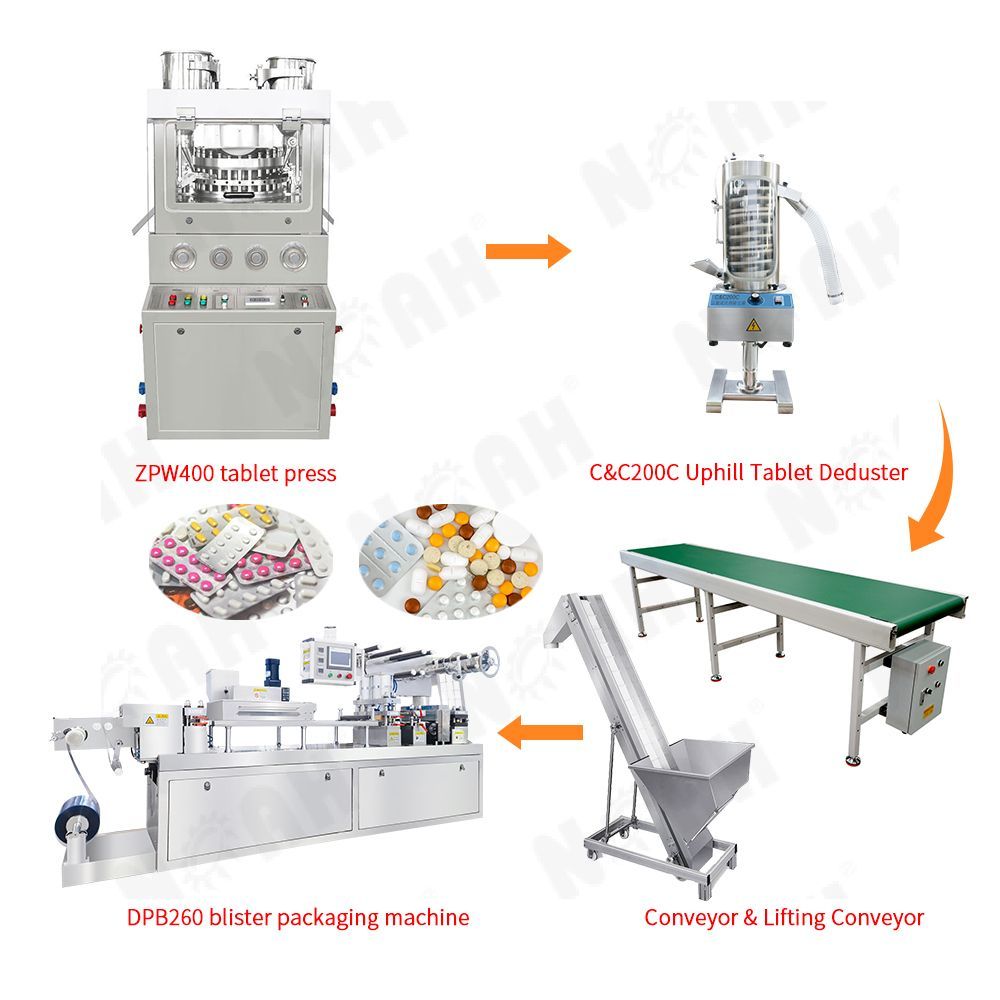
In the pharmaceutical industry, the demand for high-quality, consistent, and efficient production processes has driven the widespread adoption of automated production lines. The automatic pharmaceutical tablet production & packaging line, integrated with four core pieces of equipment—ZPW400 tablet press, C&C200C Uphill Tablet Deduster, Conveyor, and DPB260 blister packaging machine—represents a cutting-edge solution that streamlines the entire workflow from powder to finished packaged tablets. This integrated system not only enhances production efficiency but also ensures strict compliance with pharmaceutical quality standards, making it an indispensable asset for modern pharmaceutical manufacturers.

1. ZPW400 Tablet Press: The Foundation of Tablet Formation
As the primary equipment for tablet compression, the ZPW400 tablet press is engineered to deliver high precision and stability in converting pharmaceutical powders into uniform tablets. Equipped with advanced hydraulic or mechanical pressing mechanisms, this machine offers adjustable pressure and speed settings, accommodating a wide range of tablet formulations—from standard immediate-release tablets to specialized formulations like sustained-release or enteric-coated tablets. Its robust design features multiple tooling stations, enabling continuous production with a high output capacity, typically ranging from thousands to tens of thousands of tablets per hour.
What sets the ZPW400 apart is its emphasis on quality control. Integrated with real-time monitoring systems, it automatically detects and rejects defective tablets (such as those with inconsistent weight, thickness, or hardness) during the compression process. The machine’s stainless steel construction meets GMP (Good Manufacturing Practices) requirements, ensuring easy cleaning and preventing cross-contamination—critical factors in pharmaceutical production. Additionally, its user-friendly HMI (Human-Machine Interface) allows operators to set parameters, track production data, and troubleshoot issues efficiently, minimizing downtime and optimizing operational control.

After compression, tablets often carry residual dust or fine particles, which can affect product appearance, stability, and packaging efficiency. The C&C200C Uphill Tablet Deduster addresses this challenge with its specialized design, combining mechanical vibration and airflow to remove contaminants effectively. Unlike horizontal dedusters, the uphill configuration ensures that tablets move slowly and evenly through the machine, maximizing contact with the dust-removal mechanism and ensuring thorough cleaning.
The C&C200C features adjustable vibration intensity and airflow rate, allowing customization for different tablet sizes and formulations. Its closed-loop dust collection system prevents dust leakage, maintaining a clean production environment and complying with occupational health and safety regulations. Moreover, the machine’s compact design and easy integration with the tablet press and conveyor make it a seamless part of the production line, requiring minimal floor space and operational intervention.

A reliable combination of Conveyor and Lifting Conveyor is critical for connecting different production stages—whether horizontal transfer or vertical elevation—ensuring continuous, efficient material movement throughout the line. Both systems are specifically engineered for pharmaceutical applications, constructed with food-grade, non-toxic materials that fully comply with GMP standards.
The standard Conveyor features variable speed control to synchronize with the tablet press and deduster outputs, preventing bottlenecks and maintaining a steady horizontal flow of tablets. Meanwhile, the Lifting Conveyor is designed for vertical or inclined material transfer, adapting to multi-level production layouts (e.g., connecting deduster outlets to packaging machine inlets at higher elevations). It incorporates anti-slip conveying surfaces and adjustable lifting angles to ensure stable, gentle handling—avoiding tablet damage and preserving product integrity.
Both conveyors prioritize ease of use and compliance: they are equipped with guide rails to keep tablets aligned during transport, and their modular design allows easy disassembly for thorough cleaning, supporting frequent sanitization protocols required in pharmaceutical manufacturing. With durable, low-maintenance construction, the Conveyor & Lifting Conveyor system delivers long-term reliability, minimizing production disruptions and adapting to flexible production line configurations.

The DPB260 blister packaging machine is the final step in the production line, responsible for sealing tablets in individual blister packs to ensure product safety, shelf life, and tamper resistance. This machine is capable of handling various blister materials, including PVC, PVDC, and aluminum foil, accommodating different packaging designs and tablet sizes. It operates with high precision, forming blisters, filling tablets, and sealing the packs in a continuous, automated process.
Key features of the DPB260 include accurate tablet counting and positioning, ensuring each blister contains the correct number of tablets. Its sealing system uses precise temperature and pressure control to create a hermetic seal, protecting tablets from moisture, oxygen, and external contaminants. The machine also integrates quality inspection systems, such as vision sensors, to detect defective blisters (e.g., incomplete seals, missing tablets) and reject them automatically. With a high packaging speed and flexible configuration, the DPB260 can adapt to varying production demands, making it suitable for both small-batch and large-scale manufacturing.

The integration of these four core pieces of equipment creates a synergistic production system that offers numerous advantages for pharmaceutical manufacturers:
Enhanced Efficiency: By automating the entire process—from compression to packaging—the line eliminates manual handling, reduces cycle times, and increases overall production capacity. Operators can monitor and control the entire workflow from a central station, minimizing labor costs and human error.
Superior Product Quality: Each piece of equipment is designed with quality control in mind, from the ZPW400’s real-time tablet inspection to the DPB260’s blister seal verification. This multi-layered quality assurance ensures that finished products meet strict pharmaceutical standards for uniformity, purity, and stability.
Regulatory Compliance: All components of the line comply with GMP, FDA, and other international pharmaceutical regulations. The use of food-grade materials, closed-loop systems, and traceable production data (via integrated software) simplifies audit processes and ensures compliance with industry requirements.
Flexibility and Scalability: The line can be easily adjusted to accommodate different tablet formulations, sizes, and packaging designs. Whether producing over-the-counter medications, prescription drugs, or nutritional supplements, the system adapts to changing market demands without major reconfigurations.
Cost Savings: While the initial investment in automated equipment may be higher, the line delivers long-term cost savings through reduced labor, lower material waste, minimized downtime, and improved energy efficiency. Additionally, the reduction in defective products lowers rework and recall risks, protecting manufacturers’ reputations and bottom lines.

The automatic pharmaceutical tablet production & packaging line, featuring the ZPW400 tablet press, C&C200C Uphill Tablet Deduster, Conveyor, and DPB260 blister packaging machine, represents a state-of-the-art solution for modern pharmaceutical manufacturing. By integrating precision engineering, automation, and quality control, this line delivers efficient, compliant, and high-quality production processes that meet the evolving needs of the pharmaceutical industry. As manufacturers continue to prioritize product safety, efficiency, and regulatory compliance, this integrated system will remain a cornerstone of successful pharmaceutical operations, driving innovation and excellence in tablet production and packaging.
Let's find the product you want together
Look forward to your inquiry



 Download


