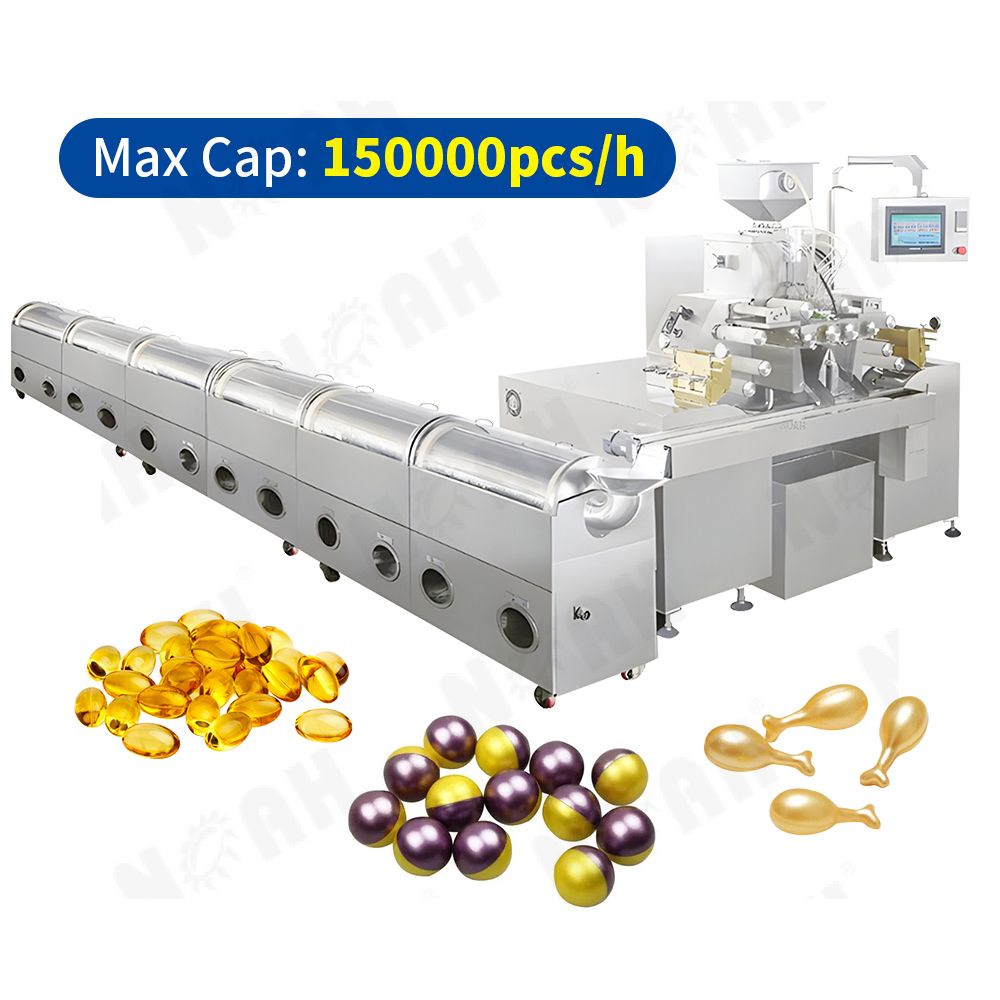
Size 1 Capsule Filler


Size 1 is the workhorse capsule — at roughly 0.5 mL body volume it covers the majority of prescription and OTC fills, and the filler you buy must be spec'd for size 1's dosing window, not for the size 00 headline most catalogs lead with.
Size 1 sits in the sweet spot: large enough for most adult doses, small enough for cost-efficient shell spend. But its dosing precision depends on powder density and the dosing disk volume, and the "60k caps/h" claim is almost always measured on size 0 or 00, not 1.
Size 1 body volume ≈ 0.50 mL. Fill weight = volume × bulk/tapped density. For a tamping filler the dosing disk is sized to the target weight; precision is set by powder flow and tamp consistency.
| Powder density (g/cm³) | Fill weight (mg, size 1) | Achievable RSD (%) |
|---|---|---|
| 0.30 (fluffy blend) | 150 | 3.5–5.0 |
| 0.50 (granule) | 250 | 2.0–3.0 |
| 0.70 (dense blend) | 350 | 1.5–2.5 |
| 0.90 (direct compress) | 450 | 1.0–2.0 |
We measured RSD of 1.8% on a 300 mg direct-compress blend at 52,000 caps/h on a 24-station intermittent filler — the size-1 sweet spot.
Size 1 uses ~15% less shell material than size 0 and ~35% less than 00, at a negligible dose-range penalty for most products. For a 250 mg dose it is the obvious choice; only high-dose (≥600 mg) products push to 0/00.
Southeast Asia, 250 mg antibiotic: A Indonesian generic standardised on size 1 across 8 SKUs, cutting shell inventory from 4 sizes to 1 and simplifying changeover; filler ran 50k caps/h with RSD 2.1%.
Middle East, 300 mg supplement: A UAE nutraceutical ran size 1 with a 0.7 g/cm³ blend; switching from size 0 saved 14% on shell cost annually with no fill-weight complaint.
EU GMP: in-process weight control per cavity group; size-1 dosing disk is a controlled part.
FDA 21 CFR 211: weight variation (USP <2091>) acceptance.
CE 2006/42/EC: standard filler safety.
ISO 9001 / ISO 13485: 13485 for device-grade capsules.
Buyers receive a size-0 validation but run size 1 — different disk, different RSD.
Fluffy blends (0.3 g/cm³) push RSD above 4% without granulation or an auger assist.
Change parts for size 1 are assumed included but often quoted separately.
Accepting a speed/RSD certificate for the wrong size.
Running size 1 on a disk sized for size 0 — under-fill.
Not budgeting the size-1 dosing disk if the quote covered only 0/00.
Tamping (most common, robust for granules) → dosator (better for powders, slightly slower) → auger-assisted (fluffy/low-density). For size 1 with varied blends, a tamping unit with an optional auger is the flexible workhorse.
Require a size-1 validation on your actual blend, not a size-0 certificate.
Confirm the size-1 dosing disk is in the base price.
Ask for RSD at your density, not the vendor's ideal granule.
If blends are fluffy, spec the auger-assist option up front.
Contact Us
Related Information!
Vacuum Blister Packaging MachinePharmaceutical EquipmentMedicine Packaging MachineTablet Blister MachineEquipment in Pharmaceutical IndustryCapsule Machine for SaleBlister Packaging MachineAutomatic Capsule FillerFluid Bed DryerEncapsulation EquipmentCapsule FillersSalt Tablet Press MachineTablet Maker Machine PriceTablet Press PowderBlister Packing Machine PricePunch and Die Tablet PressCapsule Filling Machine Size 000Capsule Filling Machine AutomaticCandy Press MachineTablet Counter MachineTablet Pressing MachineTablet Compression Machine PriceCapsule Blister Packing MachineCapsule Filling Machine South AfricaTablet CompressionEncapsulator MachineTablet making machineCompression Tablet MachineMedicine Packing MachineCapsule Maker MachineCandy Tablet PressTablet CountersSingle Press MachineTablet Counting MachineBuy Capsule Filling MachineRotary Tablet MachineCapsule Pill Filler00 Capsule MakerThe Capsule Machine Size 0Liquid Capsule Filling MachineRotary Tablet Press Machine PriceMachine A BlisterTablet Counting Machine UKLiquid Capsule MachineBlistering Machine in Pharmaceutical Industry