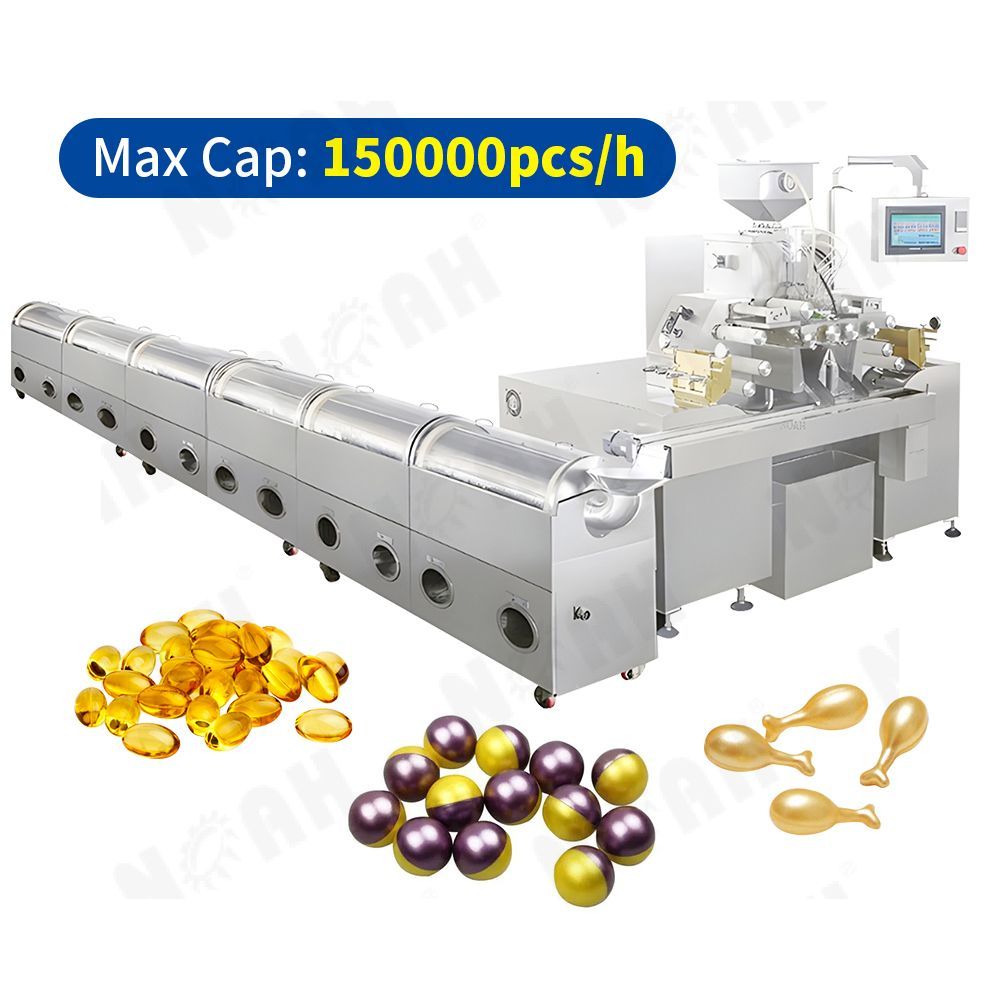
Gel Capsule Machine


Softgel encapsulation is a continuous web-forming and sealing process, not a filling-and-closing operation — and that distinction is why a gel capsule machine behaves nothing like a hard capsule filler. The gelatin ribbon is formed, shaped, filled, sealed, and cut in a single rotation of the die roll, and the variables that decide whether the capsule holds or leaks — gelatin mass viscosity, ribbon thickness uniformity, fill temperature, and die-roll engagement force — interact in ways that cannot be adjusted independently. After nine years commissioning softgel lines for pharma and nutraceutical manufacturers, I can tell you that the dominant production problem is not fill weight or output; it is seam integrity, and seam integrity is governed by the gelatin's rheological state at the moment of sealing, which is governed by the machine's temperature and ribbon geometry control. Get that chain wrong and you produce softgels that pass at line speed and leak in the drying tunnel — or worse, on the shelf.
A gel capsule machine (softgel encapsulator) works by casting two gelatin ribbons from a heated gelatin mass, feeding them over guide rolls into the gap between two matching die rolls, injecting the fill material between the ribbons at the injection wedge, and sealing and cutting the capsule as the die rolls close on the ribbons. The entire forming-filling-sealing event happens in the die-roll nip, in milliseconds, on every capsule. There is no intermediate step, no "fill then close" — the capsule is born sealed or it is born defective.
The gelatin mass is a molten blend of gelatin, plasticiser (glycerol or sorbitol), and water, held at 55–65 °C in a jacketed melting tank. Its rheology is the foundation of softgel quality. If the viscosity is too high, the ribbon is thick and uneven, and the die rolls cannot form a clean seal; if too low, the ribbon tears or the capsule walls are too thin. The mass must be degassed under vacuum to remove entrapped air, because bubbles in the ribbon create weak points that split during drying. The gelatin mass is not a static material — its viscosity drifts as water evaporates during the run, and a machine without closed-loop viscosity or temperature control on the gelatin feed tank will produce ribbon whose properties shift across the batch.
The gelatin mass flows from the tank onto a cooled drum or belt, where it solidifies into a ribbon of controlled thickness (typically 0.5–0.8 mm). The ribbon thickness is set by the gap between the spreader box and the cooling drum, and it is monitored — on better machines — by a thickness gauge that feeds back to the spreader gap. Ribbon thickness uniformity is critical because the seal is formed by two ribbons pressed together in the die; if one ribbon is 0.5 mm and the other 0.8 mm, the seal line is asymmetric and the capsule is prone to leakage at the heavier side.
As the two ribbons converge between the die rolls, the injection wedge forces fill material into the capsule cavity. The die rolls press the ribbons together around the cavity perimeter, and the gelatin — still thermoplastic from the residual heat — fuses into a continuous seal. The engagement force between the die rolls, the temperature of the gelatin at the nip, and the dwell time (governed by die-roll speed) together determine whether the seal is complete. Too little force or too low a temperature and the gelatin does not fuse; too much force and the ribbon is extruded out of the die, thinning the wall. The seal is a weld, and like any weld, it depends on temperature, pressure, and time.
The following data is drawn from commissioning and optimisation runs on production-scale softgel encapsulators handling oil-based and suspension fills. These numbers represent a well-controlled process; deviations outside these bands typically produce seam defects or wall-thickness failures.
| Process Parameter | Oil Fill (e.g., Fish Oil) | Suspension Fill (e.g., API in PEG) | Cosolvent Fill (e.g., with Propylene Glycol) |
| Gelatin mass temperature | 58–62 °C | 60–64 °C | 55–60 °C (lower — solvents affect gelatin) |
| Ribbon thickness | 0.60–0.70 mm | 0.65–0.75 mm (suspensions need thicker wall) | 0.70–0.80 mm (solvent migration risk) |
| Die-roll engagement force | 0.18–0.25 MPa | 0.20–0.28 MPa | 0.15–0.22 MPa (careful — solvents soften gelatin) |
| Fill temperature | 20–25 °C | 35–45 °C (to maintain suspension flow) | 20–25 °C |
| Die-roll speed | 3–5 rpm (≈ 5,000–8,000 sph) | 2–4 rpm (slower — suspension is viscous) | 3–5 rpm |
| Drying tunnel (initial) | 20–22 °C, 20–25% RH, 6–10 h | 22–25 °C, 25–30% RH, 10–16 h | 18–20 °C, 15–20% RH, 8–12 h |
| Final drying (room) | 20–25 °C, 30–35% RH, 24–48 h | 20–25 °C, 30–35% RH, 36–72 h | 20–25 °C, 25–30% RH, 24–48 h |
The cosolvent column deserves attention. Fill materials containing propylene glycol, polysorbate, or polyethylene glycol interact with the gelatin shell — they plasticise or soften it, which slows the drying and increases the risk of seam failure. A gel capsule machine running a cosolvent fill must run at lower gelatin temperature, lower engagement force, and lower drying-tunnel humidity, or the capsules will fuse together in the drying tunnel and split when separated. This is not a parameter you discover by reading the fill formulation; it is a parameter you discover by testing — which is why FAT with your actual fill material is non-negotiable.
Softgel encapsulation is a non-standard oral solid dosage process, and GMP validation is more complex than for tablets or hard capsules because the product is a two-component system (shell and fill) whose properties interact. The validated process must control: gelatin mass composition and viscosity, ribbon thickness, fill weight, seam integrity, and drying kinetics. The gel capsule machine's control system must log all of these as critical process parameters with Part 11 / Annex 11–compliant audit trails. Seam integrity — tested by visual inspection, pressure test, or leakage test — is a critical quality attribute that must be trended across the batch, and the machine's rejection system must remove capsules with visible seam defects in real time.
CE marking for a gel capsule machine covers the standard machinery hazards but adds a specific concern: the gelatin mass tank, the spreader box, and the injection wedge all operate at 55–65 °C and present burn and scald hazards. The interlocked guarding must prevent access to these hot surfaces during operation, and the thermal insulation must be sufficient to keep touchable surfaces below the burn threshold (typically 43 °C for metallic surfaces per EN ISO 13732-1). The die rolls also present a nip-point hazard that requires category 3 or 4 interlocks.
The die rolls are the heart of a gel capsule machine, and their manufacturing precision governs capsule-to-capsule uniformity. Each die roll is engraved with capsule-shaped cavities that must align perfectly between the upper and lower roll; a misalignment of 0.05 mm produces a mismatched seal that leaks. ISO 9001 certification of the machine manufacturer underpins the dimensional control of the die rolls, the traceability of the die-cavity geometry, and the availability of replacement rolls with consistent cavity dimensions. A supplier that cannot provide dimensional inspection certificates for replacement die rolls is a supplier whose replacement rolls may not match the originals — and that mismatch produces leakage.
Seam leakage in the drying tunnel. Capsules that appear sealed at the die roll may open in the drying tunnel as the gelatin shrinks and stresses the seam. This is the signature failure of a softgel line, and it traces to insufficient engagement force, low gelatin temperature at the nip, or a fill material that softens the shell. The remedy is not "more force" — excessive force thins the wall and causes a different failure — but a balanced optimisation of temperature, force, and ribbon thickness, validated by a destructive seam test on capsules sampled from the start, middle, and end of the batch.
Gelatin batch-to-batch variability. Gelatin is a natural product whose bloom strength, viscosity, and setting temperature vary by animal source, processing, and age. A gel capsule machine tuned for one gelatin lot may produce defective capsules when a new lot arrives. The remedy is a gelatin qualification protocol — testing each lot's viscosity and bloom before use — and a machine with adjustable gelatin temperature and spreader gap that can compensate for lot-to-lot variation.
Drying tunnel throughput bottleneck. The drying tunnel is almost always the bottleneck in a softgel line, because the capsules must dry slowly to avoid case-hardening (a dry shell with a wet core that re-wets and softens later). A high-speed encapsulator feeding a undersized drying tunnel produces a pile-up: capsules enter the tunnel faster than they can dry, and the tunnel's RH rises, which slows drying further. The encapsulator speed must be matched to the drying tunnel's capacity, not selected independently.
"Softgel is just hard capsule filling with a gelatin shell." This misconception drives the wrong purchase every time. A softgel machine is a forming-filling-sealing system, not a filling machine. The critical engineering is in the gelatin handling, ribbon formation, and die-roll sealing — not in the dosing of the fill. Buyers who evaluate softgel machines on fill-weight precision alone, without examining ribbon thickness control, gelatin temperature stability, and die-roll engagement, buy machines that fill accurately and leak consistently.
"Higher die-roll speed means more output." Die-roll speed sets the theoretical output, but the drying tunnel sets the real output. An encapsulator running at 8,000 softgels per hour into a drying tunnel that can only handle 6,000 per hour produces 2,000 defective (under-dried) capsules per hour. The line output is the drying-tunnel throughput, and the encapsulator must be slowed to match it.
"Any fill material can run on any gel capsule machine." Fill materials with cosolvents, surfactants, or high water content interact with the gelatin shell and may require a different gelatin formulation (e.g., a higher bloom strength or a modified plasticiser ratio), a different ribbon thickness, or a different machine configuration. Before purchase, the fill material must be tested on the machine — or on a pilot encapsulator — to confirm compatibility. A machine that runs fish oil flawlessly may fail completely on a PEG-based suspension fill.
| Criterion | Standard Softgel Encapsulator | High-Speed Softgel | Cap-in-Cap (Dual Capsule) |
| Forming mechanism | Die-roll, dual ribbon | Die-roll, dual ribbon, high rpm | Hard cap + body (no gelatin ribbon) |
| Fill types | Oil, suspension, cosolvent | Oil, suspension (optimised) | Powder, pellet, liquid (hard shell) |
| Typical output | 5,000–10,000 sph | 12,000–25,000 sph | 30,000–80,000 cph |
| Gelatin mass handling | Jacketed tank, manual viscosity | Closed-loop temp + viscosity | N/A (hard shell) |
| Drying tunnel required | Yes (essential) | Yes (sized to output) | No (immediate packaging) |
| Best fit | Pharma + nutraceutical softgel | High-volume single product | Pellet/bead + liquid combinations |
Demand a trial run with your fill material and your gelatin. The single most important pre-purchase test is a trial on the supplier's pilot encapsulator using your actual fill formulation and the gelatin lot you intend to use. This trial reveals fill-gelatin compatibility, the required ribbon thickness, the die-roll engagement force, and the drying kinetics — all of which are formulation-specific and cannot be predicted from a datasheet. A supplier that refuses a trial or charges excessively for it is a supplier who knows their machine may not handle your formulation.
Size the drying tunnel to the encapsulator, not the other way round. The drying tunnel's capacity (in capsules per hour at your target final moisture) must exceed the encapsulator's sustained output. If the supplier quotes the encapsulator and the drying tunnel separately without a throughput-matching calculation, insist on one. An under-sized drying tunnel is the most common reason a softgel line never reaches its rated output.
Require die-roll dimensional certificates and a re-grinding policy. Die rolls wear over time — the cavity edges round, and the seal quality degrades. The supplier should provide dimensional inspection certificates for every die-roll set, a documented re-grinding or replacement interval, and a re-grinding service that restores the original cavity geometry. Without this, die-roll wear produces a gradual decline in seam quality that is difficult to attribute and expensive to fix.
Verify gelatin mass temperature stability. The gelatin tank's temperature control must hold the mass within ±1 °C across the batch, because viscosity changes 5–8% per degree. Ask for the temperature stability data from a long run (4+ hours), not a 20-minute demonstration. A tank that drifts 3 °C over a batch will produce capsules whose seam quality changes from start to finish.
A nutraceutical manufacturer in Southeast Asia producing Omega-3 fish oil softgels was running a standard encapsulator at 7,000 softgels per hour into a drying tunnel rated for 5,000 per hour. The tunnel's relative humidity climbed to 35% during production (against a target of 22%), drying time extended to 14 hours, and 4–6% of capsules leaked or fused in the tunnel. The team's initial response was to reduce encapsulator speed to 5,000 sph, which eliminated the leakage but cut output by 29%.
The project installed a second, larger drying tunnel with independent dehumidification and a capacity of 9,000 sph at 20% RH, integrated with a tumble dryer for initial surface drying before the static tunnel. The encapsulator was returned to 7,000 sph, the initial tumble-dry stage removed surface moisture that had caused fusing, and the static tunnel held 22% RH throughout. Drying time dropped to 8 hours, leakage fell to under 0.8%, and the line's effective output rose by 40% compared to the throttled-back configuration. The investment in drying capacity — not encapsulator capacity — was what unlocked the output.
The lesson: the softgel line is a system whose throughput is set by the slowest stage, and in softgel that stage is almost always drying, not encapsulation. Selecting the encapsulator without sizing the drying infrastructure to match is the most common and most costly error in softgel plant design.
A softgel machine forms the gelatin shell in-line from a molten gelatin mass, fills it, seals it, and cuts it in one continuous operation — the shell does not exist before the machine makes it. A hard capsule liquid-fill machine uses pre-manufactured hard gelatin or HPMC capsules (capsule bodies and caps), fills the body with liquid, and seals the cap. Softgels offer superior barrier properties and bioavailability for oil-based fills; hard capsule liquid-fill offers faster changeover, no gelatin mass preparation, and no drying tunnel. The choice is driven by the formulation and the barrier requirement, not by throughput alone.
Yes, but the machine must be reconfigured: the injection wedge nozzle, the fill pump, and the gelatin mass formulation may differ between oil and suspension fills. Suspension fills are more viscous and abrasive, requiring a higher-pressure fill pump and a wear-resistant nozzle, and the gelatin ribbon may need to be thicker. The changeover is not as simple as a format change on a hard capsule filler; it involves process parameter re-optimisation. Confirm with the supplier that both fill types are supported and request a demonstrated changeover.
Initial drying in the tumble and static tunnel typically takes 6–16 hours, depending on fill type and shell thickness. Final drying (conditioning) to the target moisture takes an additional 24–72 hours in a controlled-humidity room. Drying cannot be accelerated by raising temperature without risking case-hardening — a dry shell with a wet core that re-softens and causes leakage or microbial growth. The drying time is a physical constraint of gelatin's moisture diffusion kinetics, and the drying infrastructure must be sized to accommodate it.
In addition to the standard DQ/IQ/OQ/PQ and Part 11 compliance, a gel capsule machine requires: a gelatin mass qualification protocol (viscosity, bloom, microbial limits), a seam integrity test method and acceptance criteria, a drying-tunnel performance qualification (temperature and RH mapping), a die-roll dimensional inspection record, and a fill-weight verification protocol that accounts for the two-component (shell + fill) nature of the product. The cleaning validation must address both the gelatin path (which is water-soluble and cleanable by hot water CIP) and the fill path (which may require solvent-based cleaning).
HPMC softgels are available and offer advantages for vegetarian markets and for fills that interact with gelatin (high-water or certain cosolvent fills). However, HPMC has different sealing kinetics — it requires higher sealing temperature and different die-roll engagement — and not every gel capsule machine can run HPMC without modification. If you intend to run HPMC, confirm the machine's HPMC capability at the RFQ stage and request a demonstrated trial, because the process window for HPMC is narrower than for gelatin.
Written by David Shi | Chief Industrial Application Engineer
David Shi is a Chief Industrial Application Engineer with 9 years of specialized experience in industrial drying system design, equipment selection, and production process optimization. He focuses on delivering tailored solutions for pharmaceutical, food, and chemical manufacturing, with proven expertise in GMP compliance, ISO 9001 standards, and large-scale production line integration.
Contact Us
Related Information!
Capsule Counter MachineCapsule FillersTablet Counting and Filling MachineElectronic Tablet CounterTablet Packing MachineFilling Capsule MachineCapsule Filler AustraliaCapsule Packing MmachineGel Capsule MachineTablet Pressing MachineTablet Press for SaleLiquid Capsule FillerCapsule making machineCapsule Filling Machine for SaleCapsule Filling Machine AutomaticPill capsule fillerAutomatic Capsule Filling MachineTablet Machine PriceBlister Packaging MachineBlister Packing Machine PriceFluidized Bed GranulatorTablet Press AustraliaCandy Press MachineTablet Press UKFluid Bed GranulationSingle Punch Tablet Press MachineAutomatic Blister Packing MachineCapsule Blister Packing MachineCapsule Filler South AfricaTablet Press MachineTablet Counting Machine South AfricaLiquid Capsule Filling MachineRotary Tablet MachinePill Capsule MachineCapsule Maker MachinePowder to Tablet Making MachinePharma Equipment ManufacturersCapsule Counting MachineDrug Press MachineTablet Counter MachinePharmaceutical Manufacturing MachinesBuy Capsule Filling MachineTablet MakerTablet Blister Packing MachineGel Capsule Filling Machine