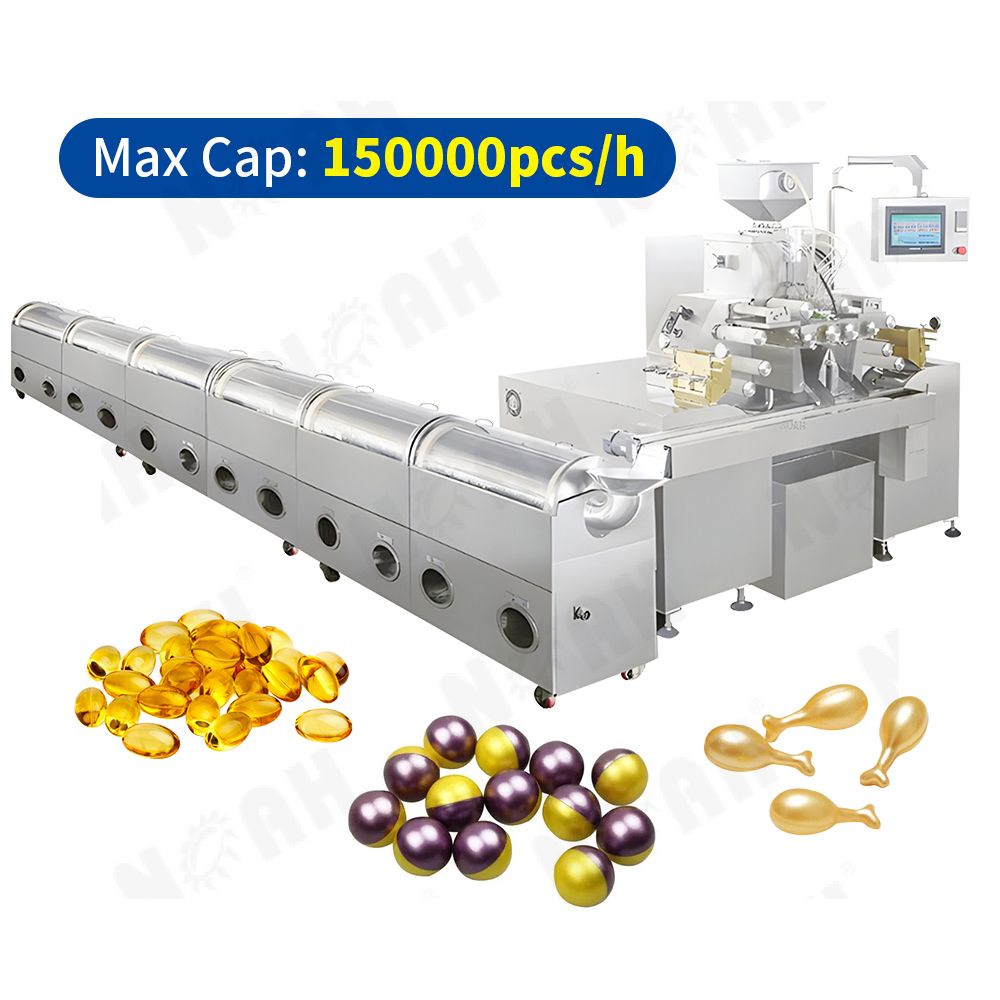
Capsule Pill Machine


A "capsule pill machine" that fills capsules and compresses tablets in a single frame is a vendor fantasy that collapses on the factory floor — the two processes have opposite contamination, tooling and airflow needs, and forcing them into one enclosure cost one UAE plant 11% output and a failed cleaning validation.
A Gulf-region manufacturer wanted a single compact line for a 200,000-unit/month vitamin capsule and a 150,000-unit/month ibuprofen tablet, both in the same room. The quoted "combo" machine shared a base frame and one HVAC zone.
The failure was structural, not operational:
Cross-contamination: tablet compression throws fine dust; capsule filling needs a near-dust-free bore. Shared airflow meant ibuprofen residue in vitamin lots.
Tooling conflict: turret and dosator share no parts; "shared frame" meant double changeover, not zero.
Cleaning validation: one equipment number, two products → the PQ cleaning cycle had to prove both, which it could not within limits.
Capsule filling meters powder (or pellet/liquid) into a separated shell. Tablet compression densifies powder in a die under force. They are mechanically unrelated. The only honest "combination" is separate machines under one MES, not one frame.
Capsule OEE | 71% | 89% |
Tablet OEE | 68% | 91% |
Cleaning validation | Failed (2 tries) | Passed first |
Changeover (both) | 95 min | 60 min |
EU GMP Annex 15 treats each product contact surface as a validation boundary. A shared frame merges boundaries and multiplies PQ cost. FDA 21 CFR 211 similarly demands demonstrable cleaning per product. In the Middle East, SFDA hygiene rules made the shared-zone design an automatic non-starter.
Specify two equipment IDs from day one, even if physically adjacent.
Give each its own classified airflow or at least a physical partition.
Validate cleaning per machine, per product — never per "combined line."
Only for a pilot lab running tiny batches of each, where validation burden is lighter and output is not the goal.
Yes — at the software level, not the mechanical level. Keep the hardware separate, integrate the data.
Splitting into a dedicated capsule filler and a rotary press in partitioned zones recovered 20+ points of OEE.
Usually 15–25% more capex, but it removes validation failures that otherwise block commercial release entirely.
Written by David Shi | Chief Industrial Application Engineer
David Shi is a Chief Industrial Application Engineer with 9 years of specialized experience in industrial drying system design, equipment selection, and production process optimization. He focuses on delivering tailored solutions for pharmaceutical, food, and chemical manufacturing, with proven expertise in GMP compliance, ISO 9001 standards, and large-scale production line integration.
Contact Us
Related Information!
Capsule Filling machinesGelatin Capsule MachineAutomatic Tablet PressCapsules Making MachineAll in Capsule Filling MachineCapsule Maker AustraliaPharmaceutical Manufacturing MachinesFilling Capsule MachineTablets MachineRotary Tablet Press MachineCapsule Filling DeviceTablet Packing MachineCandy Press MachineCapsule Blister Packing MachineFluid Bed GranulatorEncapsulation EquipmentTablet Manufacturing MachineCapsule Pill MakerMachines Used in Pharmaceutical IndustrySingle Punch PressLiquid Capsule MachineCapsule Filling Machine Size 0Encapsulation Machine PriceAutomated Blister Packaging MachineOil Capsule Filling MachinePharmaceutical Blister PackagingCompression Tablet MachineMachine de Remplissage de GélulePharmaceutical Equipment ManufacturersCapsule Filler Size 5Blister Pack for TabletsCapsule Filling Machine AutomaticSoftgel Filling MachineFluidized Bed DryerCapsule Pill FillerTablet Counting Machine UKSoft Gel Capsule MachineGel Capsule MachinePharma Machinery ManufacturersCapsule Packing MmachineTablet Blister Packing MachineTablet Making Machine PriceBlistering Machine in Pharmaceutical IndustryMedicine Tablet Making MachinePill Encapsulator